“Who can have a heart so hard that it will not melt on hearing of a most lamentable event which once happened in the world? There was a noble and holy mother who had but one only Son; and he was the most amiable that could be imagined, innocent, virtuous, beautiful, and most loving towards
his mother; so much so, that he never had caused her the least displeasure, but always had showed her all respect, obedience, and affection. Hence the mother had placed on this Son all her earthly affections. Now what happened? It happened that this Son through envy, was falsely accused by His enemies and the judge, although He knew and confessed His innocence, yet, that He might not offend His enemies, condemned Him to an infamous death, precisely as they had requested him to do. And this poor mother had to suffer the affliction of seeing that amiable and beloved Son so unjustly taken from her, in the flower of His age, by a barbarous death; for He was made to die in torment, drained of His blood before her own eyes in a public place, upon an infamous gibbet. Devout souls, what do you say? Is this case and this unhappy mother worthy of compassion?
Such love as that of Mary merits our gratitude, and let us show our gratitude by meditating upon and compassionating her sorrows. But of this she complained to St. Bridget, that very few pitied her, and most lived forgetful of her sorrows. “ I look around upon all who are in the world, if perchance there may be any to pity me, and meditate upon my sorrows, and truly I find very few. Therefore, my daughter, though I am forgotten by many, at least do not thou forget me; behold my anguish, and imitate, as far as thou canst, my grief. ” In order to understand how much the Virgin is pleased by our remembrance of her dolors, it is sufficient to relate, that in the year 1239, she appeared to seven of her servants, who then became the founders of the order of the Servants of Mary, with a black garment in her hand, and told them that if they wished to please her, they should often meditate upon her dolors; and therefore she wished, in memory of them, that they would hereafter wear that garment of mourning. And Jesus Christ Himself revealed to the blessed Veronica Binasco, that he takes more
pleasure, as it were, in seeing his mother compassionated than himself; for thus he addressed her: “My daughter, the tears shed for my passion are dear to me; but loving with so great love my mother Mary, the meditation of the dolors which she suffered at my death is more dear to me.” Wherefore the graces are very great which Jesus promises to those who are devoted to the dolors of Mary. Pelbart relates, that it was revealed to St. Elizabeth, that St. John the Evangelist, after the blessed Virgin was assumed into heaven, desired to see her again. This favor was granted him; his dear mother appeared to him, and Jesus Christ with her; and he then heard Mary asking of her Son some peculiar grace for those who were devoted to her dolors; and Jesus promised her for them the four following special graces:
1st. That those who invoke the divine mother by her sorrows, before death will merit to obtain t rue repentance of all their sins.
2d. That he will protect such in their tribulations, especially at the hour of death.
3d. That he will impress upon them the memory of his passion, and that they shall have their reward for it in heaven.
4th. That he will commit such devout servants to the hands of Mary, that she may dispose of them according to her pleasure, and obtain for them all the graces she desires. In proof of this, let us see in the following example how devotion to the dolors of Mary may aid our eternal salvation.” [1]
Feast of Our Lady of Sorrows
Devotion to the Seven Sorrows of Our Lady has its roots in Sacred Scripture and in Christian piety, which always associates the Blessed Mother with her suffering Son. The feast of Our Lady of Sorrows was introduced by the Servites in order to intensify devotion to Our Lady’s Sorrows. In 1817 Pius VII — suffering grievously in exile but finally liberated by Mary’s intercession — extended the feast to the universal Church.
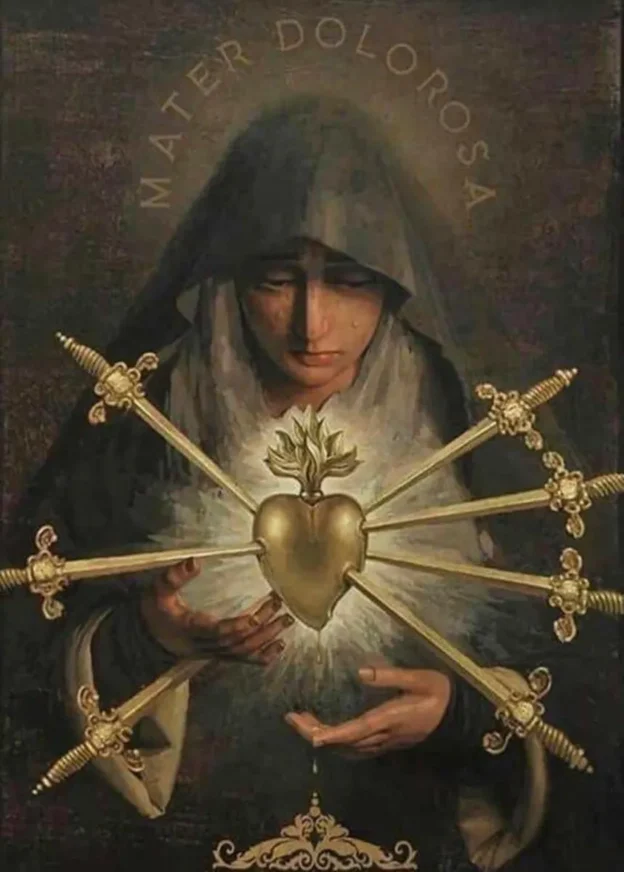
The feast dates back to the 12th century. It was especially promoted by the Cistercians and the Servites, so much so that in the 14th and 15th centuries it was widely celebrated throughout the Catholic Church. In 1482 the feast was added to the Missal under the title of “Our Lady of Compassion.” Pope Benedict XIII added it to the Roman Calendar in 1727 on the Friday before Palm Sunday. In 1913, Pope Pius X fixed the date on September 15. The title “Our Lady of Sorrows” focuses on Mary’s intense suffering during the passion and death of Christ. “The Seven Dolors,” the title by which it was celebrated in the 17th century, referred to the seven swords that pierced the Heart of Mary. The feast is like an octave for the birthday of Our Lady on September 8th. — Excerpted from Our Lady of Sorrows by Fr. Paul Haffner (Inside the Vatican, September 2004)
This feast is dedicated to the spiritual martyrdom of Mary, Mother of God, and her compassion with the sufferings of her Divine Son, Jesus. In her suffering, she reminds us of the tremendous evil of sin and shows us the way of true repentance. May the numerous tears of the Mother of God be conducive to our salvation; with which tears Thou, O God, art able to wash away the sins of the whole world.
As Mary stood at the foot of the Cross on which Jesus hung, the sword of sorrow Simeon had foretold pierced her soul.
Below are the seven sorrows of Mary:
- The prophecy of Simeon (Luke 2:25-35)
- The flight into Egypt (Matthew 2:13-15)
- Loss of the Child Jesus for three days (Luke 2:41-50)
- Mary meets Jesus on his way to Calvary (Luke 23:27-31; John 19:17)
- Crucifixion and Death of Jesus (John 19:25-30)
- The body of Jesus being taken from the Cross (Psalm 130; Luke 23:50-54; John 19:31-37)
- The burial of Jesus (Isaiah 53:8; Luke 23:50-56; John 19:38-42; Mark 15:40-47)
The Chaplet of the Seven Sorrows
The Chaplet of the Seven Sorrows is one of the devotions practiced and promoted by the seven founders of the Servants of Mary was The Chaplet of the Seven Sorrows. This chaplet consists of seven segments, one segment for each of the seven principal Sorrows or Dolors of the Blessed Virgin. Each segment of the chaplet consists of praying one Our Father and seven Hail Marys while meditating
on the particular sorrow for that segment, and followed by a special verse to be said at the end of each segment. After the prayers of the seventh segment, or seventh sorrow of Our Lady, the Salve Regina (Hail, Holy Queen) and another prayer are prayed followed by three more Hail Marys at the very end in honor of the tears Our Lady shed in Her Sorrows.
References
[1] Glories of Mary, by St Alphonsus Liguori