News

Feast of Our Lady of Sorrows – Devotion to her Seven Dolors

“Who can have a heart so hard that it will not melt on hearing of a most lamentable event which once happened in the world? There was a noble and holy mother who had but one only Son; and he was the most amiable that could be imagined, innocent, virtuous, beautiful, and most loving towards

his mother; so much so, that he never had caused her the least displeasure, but always had showed her all respect, obedience, and affection. Hence the mother had placed on this Son all her earthly affections. Now what happened? It happened that this Son through envy, was falsely accused by His enemies and the judge, although He knew and confessed His innocence, yet, that He might not offend His enemies, condemned Him to an infamous death, precisely as they had requested him to do. And this poor mother had to suffer the affliction of seeing that amiable and beloved Son so unjustly taken from her, in the flower of His age, by a barbarous death; for He was made to die in torment, drained of His blood before her own eyes in a public place, upon an infamous gibbet. Devout souls, what do you say? Is this case and this unhappy mother worthy of compassion?

Such love as that of Mary merits our gratitude, and let us show our gratitude by meditating upon and compassionating her sorrows. But of this she complained to St. Bridget, that very few pitied her, and most lived forgetful of her sorrows. “ I look around upon all who are in the world, if perchance there may be any to pity me, and meditate upon my sorrows, and truly I find very few. Therefore, my daughter, though I am forgotten by many, at least do not thou forget me; behold my anguish, and imitate, as far as thou canst, my grief. ” In order to understand how much the Virgin is pleased by our remembrance of her dolors, it is sufficient to relate, that in the year 1239, she appeared to seven of her servants, who then became the founders of the order of the Servants of Mary, with a black garment in her hand, and told them that if they wished to please her, they should often meditate upon her dolors; and therefore she wished, in memory of them, that they would hereafter wear that garment of mourning. And Jesus Christ Himself revealed to the blessed Veronica Binasco, that he takes more

pleasure, as it were, in seeing his mother compassionated than himself; for thus he addressed her: “My daughter, the tears shed for my passion are dear to me; but loving with so great love my mother Mary, the meditation of the dolors which she suffered at my death is more dear to me.” Wherefore the graces are very great which Jesus promises to those who are devoted to the dolors of Mary. Pelbart relates, that it was revealed to St. Elizabeth, that St. John the Evangelist, after the blessed Virgin was assumed into heaven, desired to see her again. This favor was granted him; his dear mother appeared to him, and Jesus Christ with her; and he then heard Mary asking of her Son some peculiar grace for those who were devoted to her dolors; and Jesus promised her for them the four following special graces:

1st. That those who invoke the divine mother by her sorrows, before death will merit to obtain t rue repentance of all their sins.
2d. That he will protect such in their tribulations, especially at the hour of death.
3d. That he will impress upon them the memory of his passion, and that they shall have their reward for it in heaven.
4th. That he will commit such devout servants to the hands of Mary, that she may dispose of them according to her pleasure, and obtain for them all the graces she desires. In proof of this, let us see in the following example how devotion to the dolors of Mary may aid our eternal salvation.” [1]

Feast of Our Lady of Sorrows

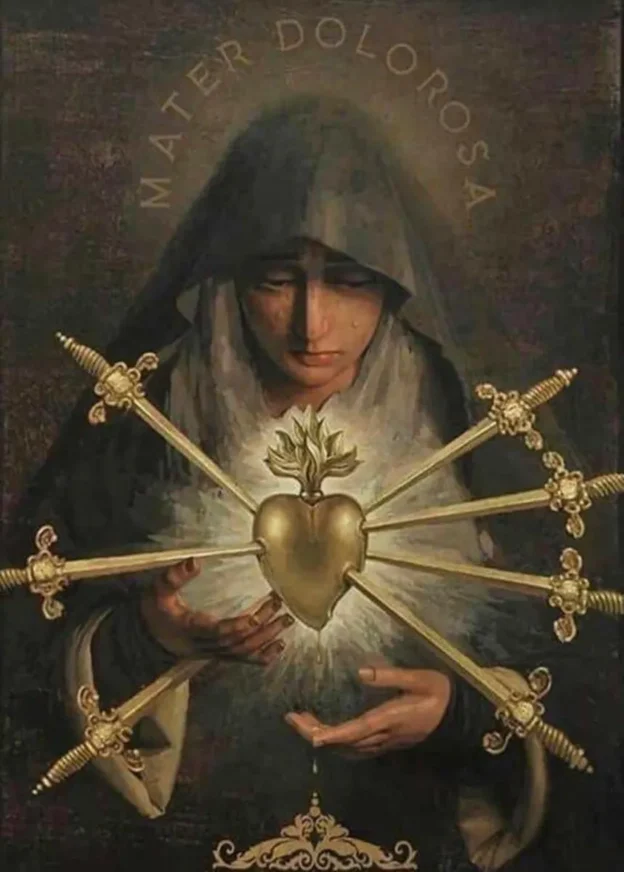
Devotion to the Seven Sorrows of Our Lady has its roots in Sacred Scripture and in Christian piety, which always associates the Blessed Mother with her suffering Son. The feast of Our Lady of Sorrows was introduced by the Servites in order to intensify devotion to Our Lady’s Sorrows.   In 1817 Pius VII — suffering grievously in exile but finally liberated by Mary’s intercession — extended the feast to the universal Church.

The feast dates back to the 12th century.  It was especially promoted by the Cistercians and the Servites, so much so that in the 14th and 15th centuries it was widely celebrated throughout the Catholic Church.  In 1482 the feast was added to the Missal under the title of “Our Lady of Compassion.”  Pope Benedict XIII added it to the Roman Calendar in 1727 on the Friday before Palm Sunday. In 1913, Pope Pius X fixed the date on September 15.   The title “Our Lady of Sorrows” focuses on Mary’s intense suffering during the passion and death of Christ. “The Seven Dolors,” the title by which it was celebrated in the 17th century, referred to the seven swords that pierced the Heart of Mary. The feast is like an octave for the birthday of Our Lady on September 8th. — Excerpted from Our Lady of Sorrows by Fr. Paul Haffner (Inside the Vatican, September 2004)

This feast is dedicated to the spiritual martyrdom of Mary, Mother of God, and her compassion with the sufferings of her Divine Son, Jesus.  In her suffering, she reminds us of the tremendous evil of sin and shows us the way of true repentance.  May the numerous tears of the Mother of God be conducive to our salvation; with which tears Thou, O God, art able to wash away the sins of the whole world.

As Mary stood at the foot of the Cross on which Jesus hung, the sword of sorrow Simeon had foretold pierced her soul.

Below are the seven sorrows of Mary:

  1. The prophecy of Simeon (Luke 2:25-35)
  2. The flight into Egypt (Matthew 2:13-15)
  3. Loss of the Child Jesus for three days (Luke 2:41-50)
  4. Mary meets Jesus on his way to Calvary (Luke 23:27-31; John 19:17)
  5. Crucifixion and Death of Jesus (John 19:25-30)
  6. The body of Jesus being taken from the Cross (Psalm 130; Luke 23:50-54; John 19:31-37)
  7. The burial of Jesus (Isaiah 53:8; Luke 23:50-56; John 19:38-42; Mark 15:40-47)

The Chaplet of the Seven Sorrows

The Chaplet of the Seven Sorrows is one of the devotions practiced and promoted by the seven founders of the Servants of Mary was The Chaplet of the Seven Sorrows. This chaplet consists of seven segments, one segment for each of the seven principal Sorrows or Dolors of the Blessed Virgin. Each segment of the chaplet consists of praying one Our Father and seven Hail Marys while meditating

on the particular sorrow for that segment, and followed by a special verse to be said at the end of each segment. After the prayers of the seventh segment, or seventh sorrow of Our Lady, the Salve Regina (Hail, Holy Queen) and another prayer are prayed followed by three more Hail Marys at the very end in honor of the tears Our Lady shed in Her Sorrows.

SevenSorrows_Chaplet

References

[1] Glories of Mary, by St Alphonsus Liguori
Attachments

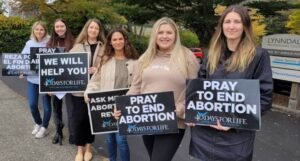
40 Days for Life – Parish Day September 26

Sign-up:  https://stclementparish.flocknote.com/signup/273681

Parish Day: Saturday September 26th – 40 Days for Life is a call to an action of silent prayer, fasting and public vigil for an end to abortion, from 7:00 am to 5:00 pm. It involves a commitment to one hour of public prayer at the southwest corner of Queen Street and Bank Street here in Ottawa. You may use the Flocknote sign-up above, or the sign-up sheet at the table at the entrance to the Church, or contact Jim Cairney (40 Days for Life Rep. at 613-229-9484 or ).  Please come pray with your fellow parishioners for an end to abortion.

Schola Cantorum for Children and Youth

Schola Cantorum for Children & Youth: Registrations Open! Lessons/rehearsals will run on Fridays from 6:00 pm to 7:15 pm, starting September 18, 2026, and the schola will sing at First Friday High Masses. Careful choral training, musical and liturgical education, spiritual formation, and a great opportunity to form lasting friendships through a shared love of the liturgy and sacred music. For more information and to register, click this link, or contact Jorge Alvarez at  for more information.

Confirmation Class for Youth

St. Clement Parish is now accepting registration forms for the Sacrament of Confirmation for youth. 

This formation in reserved to parishioners of St. Clement Parish.

Confirmation may be administered to those in grade 6 or older.

Please attach a copy of the baptismal certificates with the forms, which we need as soon as possible.

Please submit the form by Oct. 4th.  We will provide more information on the class in the coming weeks to those who have enrolled.  

The forms, in either English or French, are here below.

CONFIRMATION ENROLLMENT 2027 EN

INSCRIPTION CONFIRMATION 2027 FR

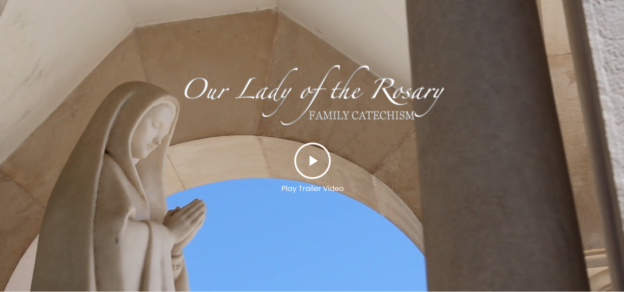
Our Lady of the Rosary Family Catechism – Online Resource


A central part of Catholic life, is the knowledge of God and teachings of the Church. This free video catechism series draws from the Baltimore Catechism, and explains the Apostles Creed, The Commandments, Sacraments and Prayer.

Now you can learn the Faith as a family together from the comfort of your own home. Each lesson is followed by a quiz to help you remember what you have learned.

Register free today to start learning !


Decree of the Dicastery for the Doctrine of the Faith with Explanatory Note

Official Decree:

Despite the warnings addressed to the Superior General of the Priestly Fraternity of St. Pius X, Bishop Alfonso de Galarreta, having committed an act of a schismatic nature through the episcopal consecration of four priests, without a pontifical mandate and against the will of the Supreme Pontiff, has incurred ipso facto the penalties provided for in can. 1387 and can. 1364 § 1 of the CIC 2021.

I therefore declare, for all legal purposes, that both the aforementioned Bishop Alfonso de Galarreta and Pascal Schreiber, Michael Goldade, Michel Poinsinet de Sivry, and Marc Hanappier have incurred ipso facto the latae sententiae excommunication reserved to the Apostolic See.

I further declare that Bishop Bernard Fellay, having participated directly in the liturgical celebration as a co-consecrator, and having thereby publicly adhered to the schismatic act, has incurred the latae sententiae excommunication provided for in can. 1364 § 1 of the CIC 2021.

Clerics and the lay faithful are warned not to adhere to the schism of the Priestly Fraternity of St. Pius X, as they would thereby incur ipso facto the penalty of latae sententiae excommunication.

From the Dicastery’s headquarters, July 2, 2026

Víctor M. Card. Fernández, Prefect
John J. Kennedy, Titular Archbishop of Ossero, Secretary for the Disciplinary Section
Mons. Armando Matteo, Secretary for the Doctrinal Section
Original Italian text:
https://www.vatican.va/roman_curia/congregations/cfaith/documents/rc_ddf_doc_20260702_decreto-scomunica-fsspx_it.html

________________________________________

Official Explanatory Note from the Dicastery for the Doctrine of the Faith

From the time of St. Paul VI up to the most recent discussions held at this Dicastery, the numerous attempts to bring the adherents of the movement founded by Archbishop Marcel Lefebvre back into full communion with the Catholic Church have proved fruitless. This situation has further worsened due to the recent episcopal consecrations celebrated without a papal mandate, against the will of the Holy Father, in open violation of canon law. Therefore, this Dicastery, in the faithful exercise of the functions entrusted to it, deems it necessary to note that this act constitutes the crime of schism, with canonical consequences for the ordained ministers and lay faithful involved.

In fact, as already stated in 1988, “such disobedience—which entails a practical rejection of the Roman Primacy—constitutes a schismatic act” (cf. John Paul II, Apostolic Letter Ecclesia Dei, 3).
In this regard, from now on:

1. Sacred ministers belonging to the Priestly Fraternity of St. Pius X are in schism and must therefore be considered schismatics (cf. Ecclesia Dei, 5 c; Pontifical Council for Legislative Texts, Explanatory Note on the Excommunication for Schism Incurred by Adherents to the Movement of Bishop Marcel Lefebvre, Aug. 24, 1996, 5–6), and are therefore subject to the excommunication prescribed by canon law (can. 1364 § 1 CIC).

2. As regards the lay faithful, those who formally adhere to the Priestly Fraternity of St. Pius X under the conditions established in the Explanatory Note of the Pontifical Council for Legislative Texts of 1996 (cf. ibid., 7), which remains in force and which this Dicastery endorses, are to be considered schismatic and excommunicated.

3. Finally, the holy People of God are hereby warned that the sacred ministers of the Priestly Fraternity of St. Pius X administer the sacraments unlawfully and that the sacrament of penance administered by them and the marriages they officiate are invalid.

The Church, as a caring mother, will welcome with sincere affection and deep concern all those who wish to return to full communion. The Apostolic Nuncios will establish the procedures that the Ordinaries may use in various cases.

Finally, all the faithful are urged to remain firm in communion with the Roman Pontiff, with the bishops in communion with him, and with the entire Church (cf. Lumen Gentium, 22; can. 751 CIC), and to refrain from participating in the celebrations and activities promoted by the aforementioned Priestly Fraternity of St. Pius X.

From the Dicastery’s headquarters, July 2, 2026

Víctor M. Card. Fernández, Prefect
Mons. Armando Matteo, Secretary for the Doctrinal Section
John J. Kennedy, Titular Archbishop of Ossero, Secretary for the Disciplinary Section
Original Italian text: https://www.vatican.va/roman_curia/congregations/cfaith/documents/rc_ddf_doc_20260702_nota-esplicativa-fsspx_it.html

23rd Annual Marie-Reine Pilgrimage 2026: Sept. 5, 6, 7

Marie Reine du Canada Annual Walking Pilgrimage: 100KM in three days, on foot, from Saint-Joseph-de-Lanoraie to Our Lady of the Cape shrine: September 5, 6, 7, 2026.

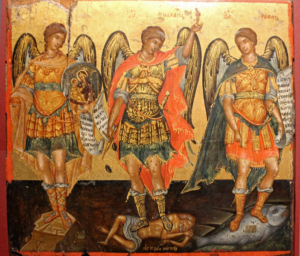
Theme for 2026: “Saint Michael the Archangel, Protector of the Universal Church” 

A pilgrimage is a journey made to a holy place or shrine for the sanctification of the pilgrim; with the purpose of venerating a saint or martyr associated with the site; to pray to God; to ask for supernatural aid; to give thanks for favours received; or to discharge a religious obligation. 

The arduous journey, offered joyfully to God, represents our spiritual pilgrimage to the Heavenly City.

Registration info: https://www.mariereine.ca/ (click on EN for the English version of the website)

Contact: 

The Error of Autocephalous Communities

This week we celebrate the Feast of Sts. Peter and Paul, a day when we commemorate the authority of St. Peter as head of the Apostles, and his faithful helper St. Paul, the great evangelizer of the Gentiles. If St. Peter is our leader in the faith, then St. Paul is his fearless soldier.  Peter, one of the 12 apostles, was made the head of the 12 by Jesus Himself.   St. Paul is considered an apostle in the Roman Liturgy, even though he was not one of the twelve, because of his extensive apostolic work.  He makes mention of his unusual status in 1 Corinthians 15 where he said that he was ‘born out of the normal course of time’, because he came to know Jesus only after he had risen from the dead, and after having himself persecuted the Church.  Paul was miraculously converted by Christ in Damascus and went from being the greatest persecutor to arguably the greatest evangelist.

Pope Emeritus Benedict XVI once remarked that  “a very ancient tradition which dates back to apostolic times claims that [St. Peter and St. Paul’s] last meeting before their martyrdom actually took place not far from [St. Peter’s Basilica]: the two are supposed to have embraced and blessed each other. [And so] on the main portal of this Basilica they are depicted together, with scenes of both martyrdoms. Thus, from the outset, Christian tradition has considered Peter and Paul to have been inseparable, even if each had a different mission to accomplish. [As St. Augustine said]: “One day is assigned for the celebration of the martyrdom of the two Apostles. But those two were one. Although their martyrdom occurred on different days, they were one” (Sermon 295, 7, 8).

St. Paul says in Galatians that after he was converted to Christ he went to consult with St. Peter for 15 days, and he said he saw none of the other Apostles except for James the Less.  Isn’t that interesting.  This is one of many passages which indicates that Peter had a chief position of authority among the Apostles. If Peter was in charge of them he was in charge of the whole church.

We know that familiar passage in Matthew when Our Lord Jesus asked the disciples:  “Who do men say that the son of man is?  And they said, “Some say John the Baptist, others say Elijah, and others Jeremiah, or one of the prophets.  He said to them, “But who do you say that I am?”.  Simon Peter replied, “Thou art the Christ the son of the living God.”  And Jesus answered him, “Blessed art thou, Simon Bar-Jona, for flesh and blood has not revealed this to thee, but my father who is in heaven.  And I say to thee, that thou art Peter, and upon this rock I will build my Church and the gates of hell will not prevail against it.”  Upon what rock?  Upon the rock of Peter, who because he professed the faith that Jesus was the son of God, by a revelation of God the Father, would become the one responsible for the preserving of the profession of faith until the end of time by some special gift of God.

There’s an old expression:  Ubi Petrus ibi ecclesia, where Peter is, there is the Church.  God has blessed all the popes with a special protection to preserve the doctrines on faith and morals, so much so that even when we had really bad Popes, and we have had about 6 or 7 of those in the history of the Church, somehow the doctrine was preserved unstained and the Church continued.  It’s a miracle really, a protection of the Holy Spirit.

Knowing this we can better understand why an “autocephalous” mentality is incompatible with our Catholic faith.  What is meant by “autocephalous”?  It’s the attitude of the Orthodox Churches – and other so-called “traditional” societies, who operate independently of the Holy See.  In doing so they consider themselves self-sufficient — as a result the Pope, the successor of St. Peter, is reduced to holding a mere primacy of honour. They pray for him, sure, but refuse to submit to his authority in any practical way.  In other words, they make themselves their own heads.

But we know this is contrary to our Catholic Faith.  We cannot operate independently of the successor of St. Peter, independently of the Holy See, without eventually falling into schism, whether material or formal.  At its core is a protestant principle – this idea that we do not really need a visible head for the Church.  This leads to a sense that the hierarchy is simply not relevant.  It explains why they are so divided as each community makes itself its own separate community.  By making themselves autocephalous they end up making the Church as a whole essentially headless.  As if the Body can operate apart from the head.  No we need to remain united to the visible Church, or, as Fr. Mole used to say, remain at the heart of the Church, despite the storms the Church experiences from within and from without.  Ubi Petrus, ibi Ecclesiae.

So as we honour Ss. Peter & Paul this week, let us renew our commitment to the Gospel by imitating St. Paul and staying united to Peter, confident in Jesus’ promise that the Gates of Hell will no prevail.  And let us renew our understanding of the faith by opening up our catechisms and studying them again, so that we too can know the faith and be apostles in our own way to those around us and under our care so that it may be passed on and preserved, so that as Catholics we may have that unity of faith so desired by Our Lord who said: “May they be One, as the Father and I are One”.  Peter and Paul were one in the Faith.  Let us ask them to pray for us, on this their feast day, for that same unity of faith.

30 Day Prayer for the FSSP

A thirty-day novena in preparation for the renewal of the Fraternity’s consecration to the Immaculate Heart of Mary is being organized this year. It will begin on Sunday, January 11, and end on February 11, the anniversary of the consecration, when the act of consecration will be publicly renewed. The preparatory thirty-day novena will consist of the daily recitation of a decade of the Rosary and the Memorare.

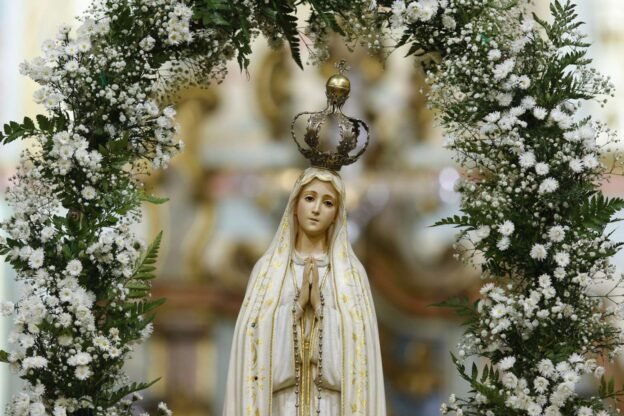
To conclude this thirty-day novena, the General House, the seminaries, the North American Province, and the Districts will send representatives this year to Fatima, on February 10 and 11, 2026. There, they will renew the consecration of the entire Fraternity to Our Lady at the site of the apparitions.

30 Day Prayer in Preparation for the Consecration of the FSSP to the Immaculate Heart of Mary:
https://www.fssp.org/en/thirty-day-novena-and-renewal-of-the-consecration-to-the-immaculate-heart-of-mary/

The consecration itself is found here:
https://www.fssp.org/en/act-of-consecration-of-the-priestly-fraternity-of-saint-peter-to-the-immaculate-heart-of-mary/

Statue Damaged

Our beloved statue of St. Clement, hand-made by the late Paul Dupuis of our parish, was accidentally disturbed and suffered a terrible fall, leaving it seriously damaged. This was quite a sight to see after my return from my silent retreat. A great silenced reigned in the Church when the terrible fall occurred. It was all very sad.

Fortunately, Mr. Dupuis had taken the precaution of having a cast made in Montreal from the original statue, from which he had a life-size copy made, and it was in the rectory.  We have placed it in the church for the time being.  But the original statue, with its distinctive anchors, is very dear to us and irreplaceable.  It was the only statue Paul Dupuis ever made, and up to his death he would say that he never understood how he managed to create it. It was as if it had been divinely inspired.

The remains are now in the able hands of Pauline and Steve Winogron, of Brushworks, who had restored our St. Philomena statue years ago, which has been shattered by the Italian postal service. The restoration work for that statue was so impressive that we have called in the “Resurrection of St. Philomena” (the video can be found below).

At this time we are seeking donations toward the restoration of our St. Clement Statue, as it is quite extensive work. Even if your donation is small, it will help with the associated expenses. Thank-you for your prayers with regard to this matter.

Sancte Clemens, ora pro nobis !

Pledge Drive (for a Parish Hall)

You will find more general information on the project itself here:
https://www.saintclement.ca/about

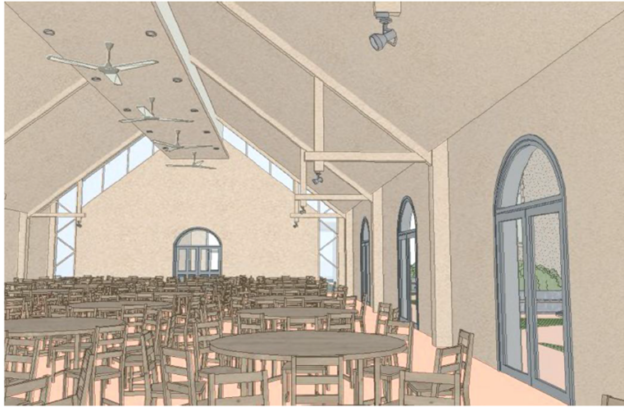
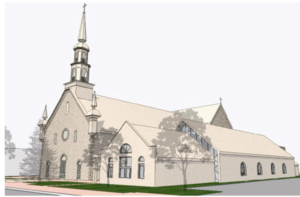
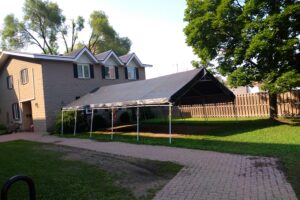
The Real Estate Committee of the Archdiocese of Ottawa-Cornwall met and passed a motion allowing our parish to continue to the Design Development phase of our Parish Hall project with the Architect. The approval of the Design Development phase is an important step forward in the architectural design process.  We would like to thank the Archdiocese for their continued support and encouragement. 

It needs to be emphasized that your pledges are essential to the process of securing a good mortgage with the Archdiocese, something we hope to work out as soon as possible.  So if you have not yet made your pledges, we encourage you to do so now. Our electronic form can be submitted using the following link:

https://www.saintclement.ca/pledge.

Alternatively, you may print off the form using the PDF link below and submit it with the Sunday Collection:

Parish Hall Pledge Form EN FR (PDF)

Or to make a donation now, use the link below:

https://www.saintclement.ca/donate

We have received $631,102 in pledges and donations so far.

This is 77% of our goal which is a good start. However, we need to build on this momentum. May God reward you for keeping this parish need between your gas and electric bill.

We appreciate the support from those who have contributed to the campaign so far. Initially, our pledge drive was seeking pledges for 2023, 2024 and 2025; however, since the pledge drive started late in 2023, we are adding 2026 to the pledge period. 

If you have any questions or require additional information regarding either the parish hall project and/or the capital campaign, contact John Fennelly @ 613-867-0144 or send an email to .

Attachments

Fatima Family Night: Rosary & BBQ

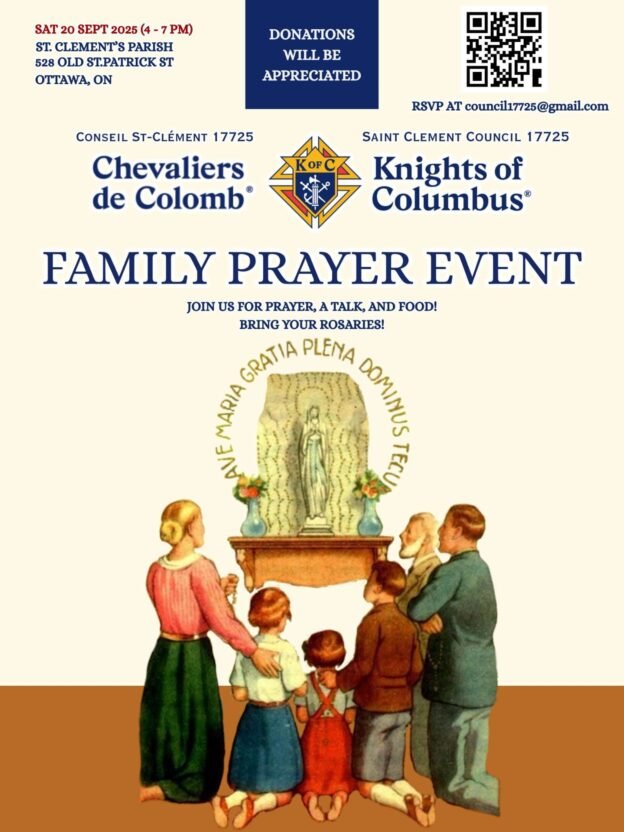
The K of C of St. Clement’s are pleased to invite you to a Fatima Family Prayer Night on Saturday Sept. 20th at 4 PM. Father Deprey will give a talk on Our Lady of Fatima in English and French, we will pray the Rosary in Latin, have Benediction of the Most Blessed Sacrament, and follow with a Family BBQ on the Church Lawn. Please fill out the Google Form below to indicate how many members of your family will be attending, whether there are dietary restrictions, and whether you would like to volunteer for any aspect of the event set up or take-down.

https://forms.gle/qJCDb2sYe1jf6oeN9

Just before the start time, at 3:30 pm, there will be Confessions available in the Church. We hope to see you there!

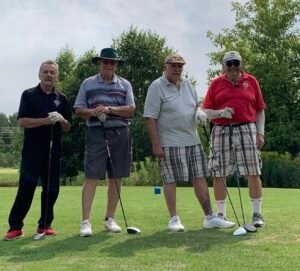
A great success ! – Golf Day 2025

Salute to our Golf Sponsors 2025.pdf

(Please open the PDF above to view our Golf Sponsors for 2025)

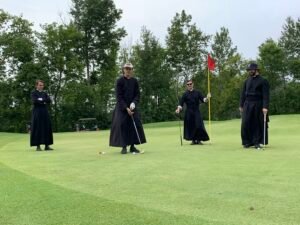
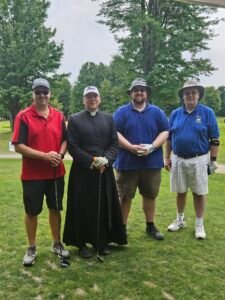
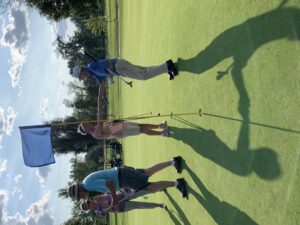
Our recent golf fundraiser was a great success. Thank you for your support!

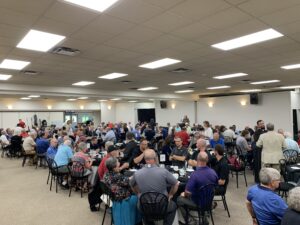
We had a record turn out for the golf and dinner, raising a record $38,300, bringing the total raised for the parish since the inception of this fundraiser to over $229,000!

This year we also had the pleasure of hosting a number of our FSSP priests and seminarians who joined us for the event.

We are very grateful to our many sponsors and generous donors for their support which included: financial and accounting services; real estate sales; property development; restaurant/catering service; and construction. All of our sponsors/donors are listed in our advertising booklet which is available at the entrance to the church and on our parish web page. We encourage you to support these businesses and professional service providers. Let’s patronize those who help us and our parish!


Saint Anne Novena: July 17-25

Prayer for each day of the Novena:

It is with a heart filled with the sincerest veneration, that I prostrate myself before thee, O blessed St. Anne. Thou art this privileged and foreknown creature, who, by thy marvelous virtues and thy sanctity, hast merited from God the heavenly grace of giving life to the treasury of all graces, to the woman blessed among all women, to the Mother of the Word incarnate, to the most-holy Blessed Virgin Mary. Knowing these privileges so sublime, deign, O Saint full of goodness, to receive me among the number of thy true servants, to which I belong and would like to belong for all of my life. Surround me with thy powerful protection and obtain for me from God to imitate the virtues with which thou wert so generously bestowed. Make it that I might know and shed bitter tears for my sins. Obtain for me a very lively love for Jesus and Mary and the grace to practice with constancy and fidelity my duties of state. Deliver me from every peril in this life and be with me at the hour of death, so that being saved, I might enter into Paradise, O Mother most happy, in order to praise with thee the Word of God made man in the bosom of thy ever-virgin Daughter, the Blessed Virgin Mary. Amen.

(Recite three times: Our Father, Hail Mary, & Glory Be.)

Litany of St. Anne
Lord, have mercy on us.
Christ, have mercy on us.
Lord, have mercy on us.
Christ, hear us.
Christ, graciously hear us.
God the Father of Heaven, have mercy on us.
God the Son, Redeemer of the world,
God the Holy Ghost,
Holy Trinity, one God,
St. Anne, pray for us.
St. Anne, mother of the Virgin Mary,
St. Anne, Spouse of St Joachim,
St. Anne, mother-in-law of Joseph,
St. Anne, Ark of Noah,
St. Anne, Ark of the Covenant,
St. Anne, Mount Horeb,
St. Anne, rod of Jesse,
St. Anne, prolific tree,
St. Anne, fruitful vine,
St. Anne, sprung from the blood of kings,
St. Anne, joy of the angels,
St. Anne, grace of Patriarchs,
St. Anne, oracle of Prophets,
St. Anne, praise of all Saints,
St. Anne, glory of priests and levites,
St. Anne, cloud full of dew,
St. Anne, cloud of light,
St. Anne, cloud of brightness,
St. Anne, vessel full of grace,
St. Anne, mirror of obedience,
St. Anne, mirror of devotion,
St. Anne, bulwark of the Church,
St. Anne, refuge of sinners,
St. Anne, protectress of Christians,
St. Anne, deliverer of captives,
St. Anne, consolation of the married,
St. Anne, mother of widows,
St. Anne, harbour of safety for navigators,
St. Anne, sure road for travellers,
St. Anne, medicine of the infirm,
St. Anne, health of the sick,
St. Anne, light of the blind,
St. Anne, tongue of the dumb,
St. Anne, ear of the deaf,
St. Anne, comforter of the afflicted,
St. Anne, succour of all those who call upon thee, intercede for us.

Lamb of God, who takes away the sins of the world, spare us O Lord.
Lamb of God, who takes away the sins of the world, graciously hear us O Lord.
Lamb of God, who takes away the sins of the world, have mercy on us.

Christ Jesus, hear us.
Christ Jesus, graciously hear us.

V. Pray for us, St Anne.
R. That we may be made worthy of the promises of Christ.

Let us pray:
O almighty and eternal God, who didst vouchsafe to choose St. Anne to bring into the world the mother of Thy only Son, mercifully grant to us, we beseech Thee, who devoutly honour her memory, grace to obtain, through her merits, the blessings of eternal life, Thou Who livest and reignest in the unity of the Holy Spirit, one God, forever and ever. Amen.

Novena to Saints Peter & Paul

The Priestly Fraternity of Saint Peter invites you to pray a Novena to Saints Peter and Paul for the good of the FSSP, which begins on Friday June 20th et finishes Saturday June 28. The Feast of Saints Peter and Paul is on Sunday June 29th.  The Novena prayer leaflet can be downloaded at the link below.  We also have pamphlets available at the entrance to the church.

Ss. Peter & Paul Novena Pamphlet

Golf Day 2025 – Tuesday, August 5

St. Clement Parish is holding its eleventh annual golf day and dinner Tuesday, August 5, 2025, to raise money for the ongoing restoration and beautification of St. Anne Church, a historic stone church located in the Lowertown area of Ottawa and a designated heritage building. St. Anne Church has been home to St. Clement Parish since 2012.

The golf committee has already started organizing this year’s golf fundraiser. These events have proved to be great successes for our parish, and you can help make this year’s tournament even more successful by identifying, on the attached document, businesses you deal with who we can approach to be sponsors.

Possible Sponsors Form – 2025

Thank you for your help with this important fundraiser for our parish.

The details may be found in the attached poster:

Poster – English – 2025

Attached is the Registration Form for you and your friends to fill out :

Registration Form – English+French -2025

The golf day is an enjoyable social event for our parish and an important fundraiser. With your help, we can raise many thousands of dollars for the needs of our church building.

Thank-you for your support and God Bless !

In Christo,
Fr. Erik Deprey, FSSP
Pastor
St. Clement Parish

1st Homily of Pope Leo XIV


FULL TEXT: Pope Leo XIV’s Homily at Mass With the Cardinal Electors in the Sistine Chapel
(Pope Leo XIV delivered this homily at his first Mass as Pope in the Sistine Chapel on May 9, the morning after being elected the 267th successor of St. Peter, addressing the cardinal electors who had chosen him.)

(extemporaneous, in English): I begin with a word in English, and the rest is in Italian, but I want to repeat the words of the responsorial psalm: I will sing a new song to the Lord because he has done marvels. And indeed, not just with me, but with all of us, my brother cardinals, as we celebrate this morning, I invite you to recognize the marvels that the Lord has done, the blessings that the Lord continues to pour out upon all of us. Through the ministry of Peter, you have called me to carry that cross and to be blessed with that mission, and I know I can rely on each and every one of you to walk with me as we continue as a church, as a community of friends of Jesus, as believers, to announce the Good News, to announce the Gospel.

(in Italian, reading): “You are the Christ, the Son of the living God” (Mt 16:16). In these words, Peter, asked by the Master, together with the other disciples, about his faith in him, expressed the patrimony that the Church, through the apostolic succession, has preserved, deepened and handed on for two thousand years.

Jesus is the Christ, the Son of the living God: the one Saviour, who alone reveals the face of the Father.

In him, God, in order to make himself close and accessible to men and women, revealed himself to us in the trusting eyes of a child, in the lively mind of a young person and in the mature features of a man (cf. Gaudium et Spes, 22), finally appearing to his disciples after the resurrection with his glorious body. He thus showed us a model of human holiness that we can all imitate, together with the promise of an eternal destiny that transcends all our limits and abilities.

Peter, in his response, understands both of these things: the gift of God and the path to follow in order to allow himself to be changed by that gift. They are two inseparable aspects of salvation entrusted to the Church to be proclaimed for the good of the human race. Indeed, they are entrusted to us, who were chosen by him before we were formed in our mothers’ wombs (cf. Jer 1:5), reborn in the waters of Baptism and, surpassing our limitations and with no merit of our own, brought here and sent forth from here, so that the Gospel might be proclaimed to every creature (cf. Mk 16:15).

In a particular way, God has called me by your election to succeed the Prince of the Apostles, and has entrusted this treasure to me so that, with his help, I may be its faithful administrator (cf. 1 Cor 4:2) for the sake of the entire mystical Body of the Church. He has done so in order that she may be ever more fully a city set on a hill (cf. Rev 21:10), an ark of salvation sailing through the waters of history and a beacon that illumines the dark nights of this world. And this, not so much through the magnificence of her structures or the grandeur of her buildings — like the monuments among which we find ourselves — rather through the holiness of her members. For we are the people whom God has chosen as his own, so that we may declare the wonderful deeds of him who called us out of darkness into his marvellous light (cf. 1 Pet 2:9).

Peter, however, makes his profession of faith in reply to a specific question: “Who do people say that the Son of Man is?” (Mt 16:13). The question is not insignificant. It concerns an essential aspect of our ministry, namely, the world in which we live, with its limitations and its potential, its questions and its convictions.

“Who do people say that the Son of Man is?” If we reflect on the scene we are considering, we might find two possible answers, which characterize two different attitudes.

First, there is the world’s response. Matthew tells us that this conversation between Jesus and his disciples takes place in the beautiful town of Caesarea Philippi, filled with luxurious palaces, set in a magnificent natural landscape at the foot of Mount Hermon, but also a place of cruel power plays and the scene of betrayals and infidelity. This setting speaks to us of a world that considers Jesus a completely insignificant person, at best someone with an unusual and striking way of speaking and acting. And so, once his presence becomes irksome because of his demands for honesty and his stern moral requirements, this “world” will not hesitate to reject and eliminate him.

Then there is the other possible response to Jesus’ question: that of ordinary people. For them, the Nazarene is not a charlatan, but an upright man, one who has courage, who speaks well and says the right things, like other great prophets in the history of Israel. That is why they follow him, at least for as long as they can do so without too much risk or inconvenience. Yet to them he is only a man, and therefore, in times of danger, during his passion, they too abandon him and depart disappointed.

What is striking about these two attitudes is their relevance today. They embody notions that we could easily find on the lips of many men and women in our own time, even if, while essentially identical, they are expressed in different language. Even today, there are many settings in which the Christian faith is considered absurd, meant for the weak and unintelligent. Settings where other securities are preferred, like technology, money, success, power, or pleasure.

These are contexts where it is not easy to preach the Gospel and bear witness to its truth, where believers are mocked, opposed, despised or at best tolerated and pitied. Yet, precisely for this reason, they are the places where our missionary outreach is desperately needed. A lack of faith is often tragically accompanied by the loss of meaning in life, the neglect of mercy, appalling violations of human dignity, the crisis of the family and so many other wounds that afflict our society.

Today, too, there are many settings in which Jesus, although appreciated as a man, is reduced to a kind of charismatic leader or superman. This is true not only among non-believers but also among many baptized Christians, who thus end up living, at this level, in a state of practical atheism.

This is the world that has been entrusted to us, a world in which, as Pope Francis taught us so many times, we are called to bear witness to our joyful faith in Christ the Saviour. Therefore, it is essential that we too repeat, with Peter: “You are the Christ, the Son of the living God” (Mt 16:16).

It is essential to do this, first of all, in our personal relationship with the Lord, in our commitment to a daily journey of conversion. Then, to do so as a Church, experiencing together our fidelity to the Lord and bringing the Good News to all (cf. Lumen Gentium, 1).

I say this first of all to myself, as the Successor of Peter, as I begin my mission as Bishop of Rome and, according to the well-known expression of Saint Ignatius of Antioch, am called to preside in charity over the universal Church (cf. Letter to the Romans, Prologue). Saint Ignatius, who was led in chains to this city, the place of his impending sacrifice, wrote to the Christians there: “Then I will truly be a disciple of Jesus Christ, when the world no longer sees my body” (Letter to the Romans, IV, 1). Ignatius was speaking about being devoured by wild beasts in the arena — and so it happened — but his words apply more generally to an indispensable commitment for all those in the Church who exercise a ministry of authority. It is to move aside so that Christ may remain, to make oneself small so that he may be known and glorified (cf. Jn 3:30), to spend oneself to the utmost so that all may have the opportunity to know and love him.

May God grant me this grace, today and always, through the loving intercession of Mary, Mother of the Church.

Prayers for the Papal Conclave choosing a new Pope

Prayer for the election of the Sovereign Pontiff

V. I will raise Me up a faithful priest, who shall do
according to My Heart and My soul.

R. And I will build him a faithful house: and he
shall walk all day before My Anointed.

Let us pray.
We most humbly entreat Thee, O Lord, that Thy
boundless goodness may grant as pontiff to the
most holy Roman Church one who shall ever be
both pleasing to Thee, by his loving zeal in our
regard, and, by his beneficent rule, deeply revered by
Thy people to the glory of Thy name. Through
Christ our Lord.
R. Amen.

Lingua Latina:
V. Suscitabo mihi sacerdotem fidelem, qui iuxta
cor meum, et animam meam faciet.

R. Et aedificabo ei domum fidelem, et
ambulabit coram Christo meo cunctis diebus.

Orémus.
Súpplici, Dómine, humilitáte depóscimus: ut
sacrosánctæ Románæ Ecclésiæ concédat
Pontíficem illum imménsa píetas; qui et pio in
nos stúdio semper tibi plácitus, et tuo pópulo pro
salúbri regímine sit assídue ad glóriam tui
nóminis reveréndus. Per Christum Dóminum
nostrum.
R. Amen