The Apostolic Penitentiary issued a Decree granting plenary indulgences for the year of St. Joseph proclaimed by Pope Francis. The special year will last from 8 December 2020 to 8 December 2021, on the occasion of the 150th anniversary of the proclamation of St. Joseph as the Patron of the Universal Church, as well as the Solemnity of the Immaculate Conception of Our Lady.
The Apostolic Penitentiary also issued a decree granting special indulgences for the duration of the special year to celebrate the anniversary and “to perpetuate the entrustment of the whole Church to the powerful patronage of the Custodian of Jesus.”
During this period, the faithful will have the opportunity to commit themselves “with prayer and good works, to obtain, with the help of St. Joseph, head of the heavenly Family of Nazareth, comfort and relief from the serious human and social tribulations that besiege the contemporary world today.”
Devotion to St. Joseph
The decree signed by Cardinal Mauro Piacenza, the Major Penitentiary of the Apostolic Penitentiary, and the Regent, Fr. Krzysztof Nykiel, notes that devotion to St. Joseph has grown extensively throughout the history of the Church, “which not only attributes to him high reverence after that of the Mother of God his spouse but has also given him multiple patronages.”
At the same time, the Magisterium of the Church continues to discover “old and new greatness in this treasure which is St. Joseph, like the master in the Gospel of Matthew who brings from his storeroom both the new and the old.”
Therefore, the gift of indulgences granted through a decree of the Apostolic Penitentiary by mandate of the Holy Father “will be of great benefit to the perfect attainment of the appointed purpose.”
Conditions for the plenary indulgence
The plenary indulgence is granted to the faithful under the usual conditions (sacramental confession, Eucharistic Communion, and prayer for the Pope’s intentions) to Christians who, with a spirit detached from any sin, participate in the Year of St. Joseph on these occasions and manners indicated by the Apostolic Penitentiary:
– The plenary indulgence is granted to those who will meditate for at least 30 minutes on the Lord’s Prayer, or take part in a Spiritual Retreat of at least one day that includes a meditation on St. Joseph. “St. Joseph, an authentic man of faith, invites us”, the decree reads, “to rediscover our filial relationship with the Father, to renew fidelity to prayer, to listen and correspond with profound discernment to God’s will.”
– The indulgence can also be obtained by those who, following St. Joseph’s example, will perform a spiritual or corporal work of mercy. St. Joseph “encourages us to rediscover the value of silence, prudence and loyalty in carrying out our duties,” the decree notes.
– The recitation of the Holy Rosary in families and among engaged couples is another way of obtaining indulgences, in order that “all Christian families may be stimulated to recreate the same atmosphere of intimate communion, love and prayer that was in the Holy Family.”
– Everyone who entrusts their daily activity to the protection of St. Joseph, and every faithful who invokes the intercession of St. Joseph so that those seeking work can find dignifying work can also obtain the plenary indulgence. On 1 May 1955, Pope Pius XII instituted the feast of St. Joseph “with the intent that the dignity of work be recognized by all, and that it inspires social life and laws, based on the fair distribution of rights and duties.”
– The plenary indulgence is also granted to the faithful who will recite the Litany to St. Joseph (for the Latin tradition), or the Akathistos to St. Joseph (for the Byzantine tradition), or any other prayer to St. Joseph proper to the other liturgical traditions, for the persecuted Church ad intra and ad extra, and for the relief of all Christians suffering all forms of persecution. Because, the decree notes, “the flight of the Holy Family to Egypt shows us that God is there where man is in danger, where man suffers, where he runs away, where he experiences rejection and abandonment.”
A universal saint
In addition to these, the Apostolic Penitentiary grants a plenary indulgence to the faithful who will recite any legitimately approved prayer or act of piety in honor of St. Joseph, for example, “To you, O blessed Joseph” especially on “19 March, on 1 May, the Feast of the Holy Family of Jesus, Mary and Joseph, on St. Joseph’s Sunday (according to the Byzantine tradition) on the 19th of each month and every Wednesday, a day dedicated to the memory of the saint according to the Latin tradition.”
The decree recalls the universality of St. Joseph’s patronage of the Church, noting that St. Teresa of Ávila recognized him as “a protector for all the circumstances of life”. Pope St. John Paul II also said that St. Joseph has “a renewed relevance for the Church of our time, in relation to the new Christian millennium.”
For the sick
Amid the ongoing Covid-19 health crisis, the gift of the plenary indulgence is also extended to the sick, the elderly, the dying and all those who for legitimate reasons are unable to leave their homes.
They too can obtain the plenary indulgences if they are detached from any sin and have the intention of fulfilling, as soon as possible, the three usual conditions and recite an act of piety in honor of St. Joseph, offering to God the pains and hardships of their lives.
The role of priests
The Apostolic Penitentiary encourages priests to pastorally facilitate the celebration of the Sacrament of Penance and the administration of Holy Communion to the sick with a willing and generous spirit.

To download the prayers, click on the link below:
Prayers of Protection with the Blessing of the True Cross EN LT FR 2020
Sat: 8:00-noon
Sunday: 8:00-2:00.
Used and new books Christmas items Calendars
Used and new items Gift cards Gift ideas
WE ACCEPT CASH AND CHEQUE ONLY
DECREE
This year, in the current circumstances due to the “Covid-19” pandemic, the Plenary Indulgences for the deceased faithful will be extended throughout the entire month of November, with adaptation of works and conditions to guarantee the safety of the faithful.
This Apostolic Penitentiary has received many petitions from holy Pastors who have asked that this year, due to the “Covid-19” epidemic, pious works be commuted in order to obtain the Plenary Indulgences applicable to souls in Purgatory, in accordance with the Manual of Indulgences (conc. 29, § 1). For this reason, the Apostolic Penitentiary, on the special mandate of His Holiness Pope Francis, willingly establishes and decides that this year, in order to avoid gatherings where they are forbidden:
a.- the Plenary Indulgence for those who visit a cemetery and pray for the deceased, even if only mentally, normally established only on the individual days from 1 to 8 November, may be transferred to other days of the same month, until its end. These days, freely chosen by the individual believers, may also be separate from each other;
b- the Plenary Indulgence of 2 November, established on the occasion of the Commemoration of all the deceased faithful for those who piously visit a church or oratory and recite the “Our Father” and the “Creed” there, may be transferred not only to the Sunday before or after or on the day of the Solemnity of All Saints, but also to another day of the month of November, freely chosen by the individual faithful.
The elderly, the sick and all those who for serious reasons cannot leave their homes, for example because of restrictions imposed by the competent authority in this time of the pandemic, in order to prevent numerous faithful from crowding into the holy places, will be able to obtain the Plenary Indulgence as long as they join spiritually with all the other faithful, completely detached from sin and with the intention of complying as soon as possible with the three usual conditions (sacramental confession, Eucharistic communion and prayer according to the Holy Father’s intentions), before an image of Jesus or the Blessed Virgin Mary, recite pious prayers for the deceased, for example, Lauds and Vespers of the Office of the Dead, the Marian Rosary, the Chaplet of Divine Mercy, other prayers for the deceased dearest to the faithful, or occupy themselves in considered reading of one of the Gospel passages proposed by the liturgy of the deceased, or perform a work of mercy by offering to God the sorrows and hardships of their own lives.
For an easier attainment of divine grace through pastoral charity, this Penitentiary earnestly prays that all priests with the appropriate faculties offer themselves with particular generosity to the celebration of the Sacrament of Penance and administer Holy Communion to the sick.
However, as far as the spiritual conditions for fully achieving the Indulgence are concerned, it is worth recalling the indications already issued in the “Note on the Sacrament of Reconciliation in the current pandemic” issued by the Apostolic Penitentiary on 19 March 2020.
Finally, since the souls in Purgatory are assisted by the prayers of the faithful and especially by the sacrifice of the Altar to God (cf. Conc. Tr. Sess. XXV, decr. De Purgatorio), all priests are strongly invited to celebrate Holy Mass three times on the day of the Commemoration of all the deceased faithful, in accordance with the Apostolic Constitution “Incruentum Altaris“, issued by Pope Benedict XV, of venerable memory, on 10 August 1915.
This Decree is valid throughout the entire month of November, notwithstanding any provision to the contrary.
Given in Rome, from the seat of the Apostolic Penitentiary, on 22 October 2020, memorial of Saint John Paul II.
Maurus Card. Piacenza
Paenitentiarius Maior
===
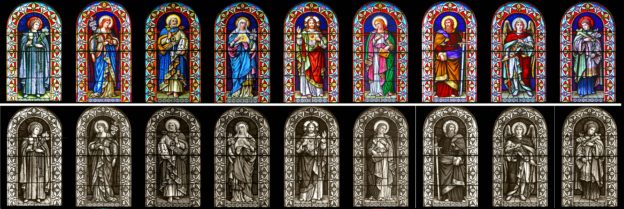
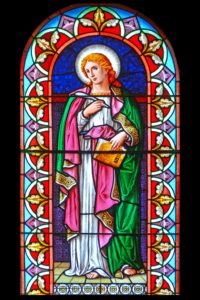
Restoration of the sanctuary windows is completed ! The exterior glass and wooden frames also needed repair. We discovered that they had been installed backwards at some point in their history, perhaps when the exterior windows were replaced at some point.
The photo above shows the previous arrangement (in black and white); the colour photos show how they are now arranged. The PDF file here can show you in more detail on your computer: Sanctuary Windows
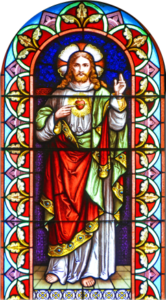
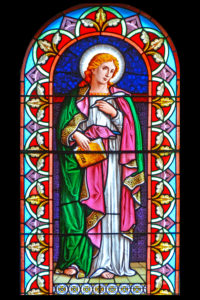
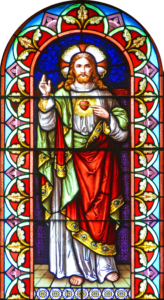
This means we have restored them to their proper orientation, having the faces of the saints facing Our Lord, and Our Lord blessing us with his right hand, as is proper:
Before:

Restored:

We thank you for your donations which helped pay for this restoration work. May God reward you for your generosity !
Julian
Today (Sept. 20) begins the 9 days before the Feast of St. Michael the Archangel. Please join us in reciting daily in your homes the Litany of St. Michael (attached). I would ask that you pray especially for the protection of our parish and especially for the protection of the Blessed Sacrament reserved in our tabernacle. An unsuccessful attempt was made this week to break into the church (the young man ripped out the exterior security keypad in the process then gave up) which is one of the reasons why I ask that you consider praying this for our needs here. God Bless you and keep you in these difficult times !
You may download the Litany by clicking on the link below, which will open a document in PDF format:
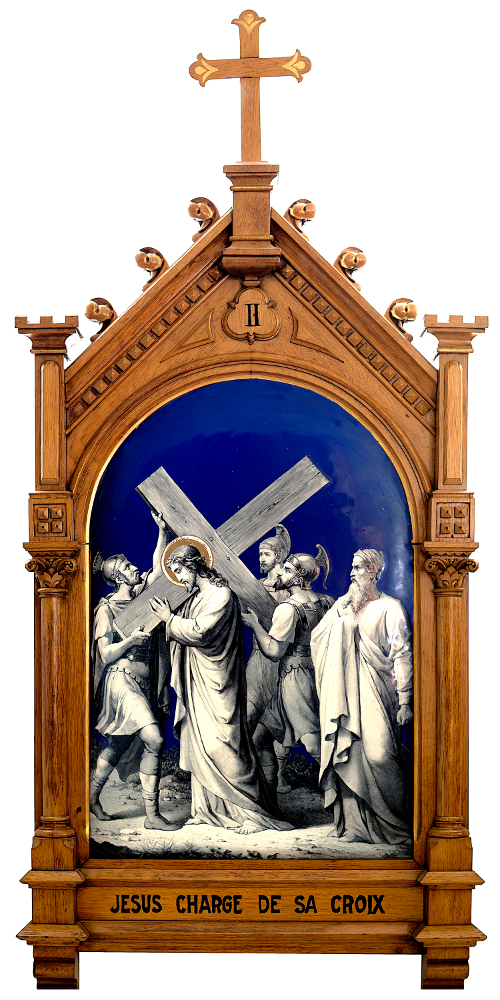
The Via Crucis – commonly known as the Way of the Cross – is a devotional exercise which allows the faithful to retrace the stations or events surrounding the Passion of Our Lord and to meditate upon their profound meaning. The fourteen stations illustrating particular events along the Way up to Calvary formerly varied considerably in number at different times and places until the eighteenth century when the devotion’s definitive form was established by popes Clement (1731) and Benedict XIV (1741). Today the Stations of the Cross are to be found in almost every church and chapel around the world. The scenes making up the Stations beginning with the Condemnation of Jesus and ending with the Placing of His Body in the Tomb are set at intervals around the church interior. As the faithful move from one to another of the stations along the “road” the fourteen are meant to recall, they follow the outlines of the church’s exterior form. In a sense then, the Via Crucis itself represents the entirety of the material symbols making up the individual “stations”.
The new Limoges Way of the Cross now installed in the nave constitutes a work of art. Very finely executed, each scene of the Via Crucis is painted in monochrome tones of grey against a blue background and laid down on enameled copper in a technique whose preliminary steps involve embossing a copper sheet to produce a convex surface able to resist successive firings which is in turn hammered to further enhance its rigidity. The composition is created by superimposing successive layers of enamel, each one applied and fired separately, beginning with the colours most resistant to the highest temperatures. The Via Crucis scenes were executed in France, possibly at Limoges, where the ancient technique of decorative enameling enjoyed a renaissance in the second half of the nineteenth century and the series produced under patent issued to the Parisian firm located in the Saint Sulpice quarter owned by Lucien Chovet who specialized in painting, gilding, bronze casting and the production of church ornaments. It has thus far been impossible to identify the individual artists responsible for the realistic scenes depicted by the Via Crucis. Each scene is surrounded by a niche-shaped frame of carved oak, stained, gilded and crowned with a cross. The 1889 gift to their chapel by members of the Congrégation de Saint-Roch de Québec, the Stations of the Cross were installed on January 10th 1890. In honour of the Congrégation’s fiftieth anniversary, their chapel was elevated to a church in 1901 and given the name Notre-Dame-de-Jacques-Cartier. A reorganization of Québec City parishes resulted in the church being closed in 2012. We are honoured to have been gifted such a fine example of the Via Crucis by the Council of the Fabrique of Notre-Dame de Saint-Roch. Contemporary with the period when Saint Anne Church was built, it complements the church’s interior superbly, inspires meditation and advantageously replaces the plaster castings formerly in place which had been substantially altered during renovations carried out in the church’s interior in 1967 when their frames were removed and white paint applied to them.
The installation of this superb Via Crucis represents the first important step in the restoration of the original dignity of Saint Anne Church, and its conformity to the liturgical requirements of the Extraordinary Form of the Catholic Liturgy.
– René Villeneuve, July 2014
![]() |
![]() |
|---|---|
![]() |
![]() |
![]() |
![]() |
![]() |
![]() |
![]() |
![]() |
![]() |
![]() |
![]() |
![]() |
Photos: Jean-Claude Grant
+JMJ
Dear parishioners,
By now you have probably heard in the news that Ottawa Public Health is imposing the wearing of masks for those entering indoor public spaces throughout the Ottawa Area, to help prevent the spread of COVID-19. This mandatory policy includes places of worship. Ottawa Health expects the parish to inform parishioners of the policy with the view of fostering compliance; at the same time, the policy provides exemptions for certain people, such as those with pre-existing medical conditions such as, for example, “respiratory difficulties”. There are exemptions as well for those working in areas where the public are not supposed to have access (i.e. sacristy, sanctuary, choir loft). The policy is reported in this CTV News report:
After a grace period, the policy will be reviewed on July 15th by Ottawa City Council with the view of voting on amendments and/or bylaws regarding masks. If you live in the Ottawa area now would be the time to contact your city councillor to suggest any constructive modifications or amendments which may be on your mind :
https://ottawa.ca/en/city-hall/mayor-and-city-councillors
We have been through a lot in the past few months and for many of us our patience has been tried to the limit; at the same time we don’t want anyone to get ill with COVID-19, especially the most vulnerable, and so are asked to wear a mask. You will be facing a new challenge when going to the bank, grocery store, or any indoor space in the city. At the same time we should be grateful that our Church is open for Mass and, despite the social distancing requirements, that we have access to the Holy Sacrifice of the Mass, Confession, and Holy Communion.
How are we to manage our emotions in unsettling times like these, when things seemed to be getting back to normal until, suddenly, we realize they are not? When news of this policy broke, I was advancing in my reading of a fine book published by Angelico Press called In Sinu Jesu – When Heart Speaks to Heart: The Journal of a Priest at Prayer which was written by a Benedictine Monk who founded the traditional Silverstream Priory in County Meath Ireland. It is a diary of sorts recording inspirations received during Eucharistic Adoration, and a book which encourages priests to spend time before the Blessed Sacrament every day in order to renew their love for Our Lord and build up their interior life. The book is highly recommended by His Eminence Cardinal Burke, former head of the Roman Rota and Patron of the Sovereign Military Order of Malta. On p. 69 this monk shares an inspiration from Our Lord:
“Trust Me with all the events of your life. I will not abandon you. You are Mine and I will not forsake you. The decisions of men are all in My hands. Nothing will befall you that I do not permit. I will give you My grace to accept the changing circumstances of your life. It is I who am behind all that happens to you. Nothing escapes My wisdom; nothing escapes My love; nothing escapes My omnipotence. Trust Me, and be at peace. I bless you with all the love of My Sacred Heart. Do not be afraid. Tell Me again and again that you trust in My merciful love for you.”
So as we try to process all these changes around us, and the inconveniences associated with them, let us all strive to supernaturalize them as best we can. Because, in the end, Our Lord is the Lord of Heaven and Earth. Our life is in His hands. We have no better place to turn to than His Sacred Heart to help weather this storm and to be at peace within it. We should trust in Him.
You remain in my prayers.
In Corde Mariae,
Fr. Erik Deprey, FSSP
Pastor
Because of the current COVID-19 virus emergency, the Confession needs to be handled differently. On Sundays and weekdays we will have confession stations set up in front of the rectory. If it rains, we will use tents (remember to bring an umbrella!).
Please consider joining us in the Rosary Crusade for and end to this COVID-19 virus crisis. More information on this can be found on our website.

We will be posting our daily Masses here for you to view throughout the COVID-19 crisis ! We also have a new Schedule:
Monday to Friday: 7:00 am live-streamed Mass
Saturday: 7:00 am live-streamed mass
Sunday: 11:00 am live-streamed mass
Here is the link for our Channel:
St. Clement Parish Youtube Channel
The Readings for Mass can also be found on our website here:
Daily Readings in English
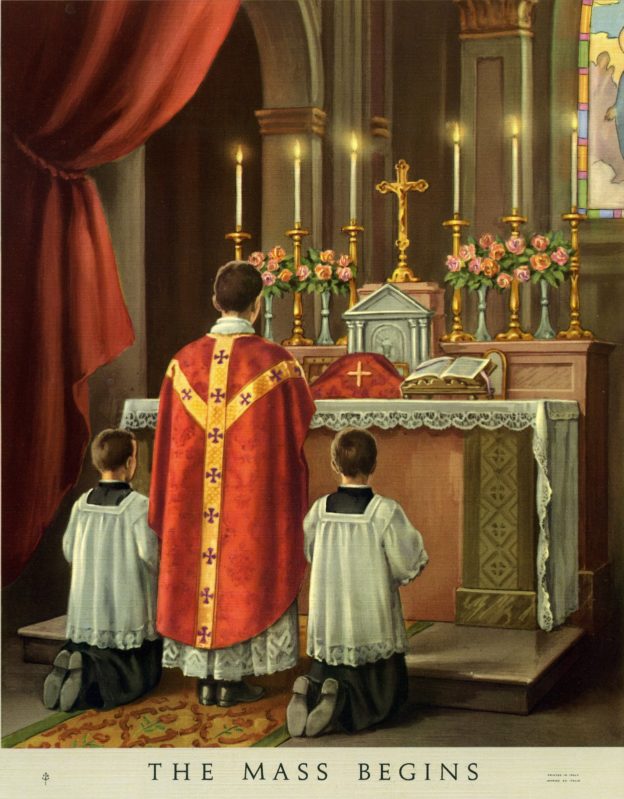
Those of you unfamiliar with the Extraordinary Form of the Roman Rite Mass will find this video quite helpful as an overview of the Liturgy used at St. Clement Parish. The Video was done by Fr. Calvin Goodwin, FSSP :
https://www.youtube.com/watch?v=TuKTXxKykbo
The Masses at St. Clement Parish will be recorded onto our Youtube site so that you can watch it later if for some reason you can’t see it live.
Keep this in mind as you plan your prayers at home with the family.
Take courage and may God bless you ! We are praying for you !
The Novena can be downloaded from the link below:
April 25 is known as the “Major Rogation” which was instituted by Pope St. Gregory the Great (b. 540) after a great plague besieged Rome. It also became associated with the blessing of farms, for a good harvest. It involves a procession and coincides with the Feast of St. Mark. I would invite you all to consider doing a home procession tomorrow for the protection of your family and property. You could begin at your family altar, and go outside (if you can) to do the Litany of the Saints. The priests here will also process around the Church with the same intention. You can download the booklet here to follow the prayers, or use any 1962 daily hand missal:
Rogation Day Procession and Mass Readings
The rogation prayers can be found in most hand missals (see the indications in your missals for April 25th) and begins with an antiphon taken from Psalm 43:26 –“Arise, O Lord, help us and redeem us for Thy name’s sake”. Afterwards, all kneel for the chanting of the Litany of the Saints. At the Litany’s “Sancta Maria”, all stand and the procession begins, which in older times would take place around the boundaries of the territorial parish. Families may also do this at home by processing around their property, sprinkling Holy Water as they go around. One of your boys could hold a cross decorated with flowers to lead the way. After the Litany all can re-assemble at the family altar for the recitation of Psalm 69, followed by a series of petitions for the needs of the Church and for deliverance from general calamity. You could end by reading the following readings from the Rogation Mass: James 5:16-20 and Luke 11:5-14, which emphasize the importance of repentance and prayers of petition.
Let us continue to unite our forces in prayer for the protection of our families and an end to the current COVID-19 crisis. You are being remembered daily at the altar in our masses. Take courage and remember that Our Lord has won the victory over sin and death! He is Risen – Alleluja !
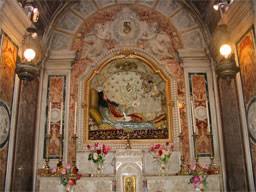
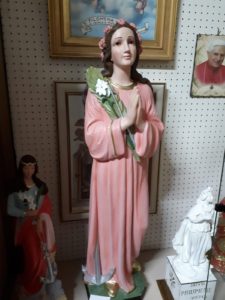
St. Clement Parish acquired, through the donation of a generous donor, a statue of St. Philomena. The journey was quite eventful so we would like to share the story with you. A video of the restoration of the statue can be found below. Fr. Breton had obtained the statue at the Shrine of St. Philomena in Mugnano, Italy (featured above). The statue looked like this in the shop:

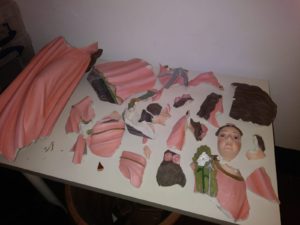
Much to our dismay, while in the hands of the Italian postal service, she ended up arriving like this :

The Italian postal service did not respond to our request for assistance and/or reimbursement.
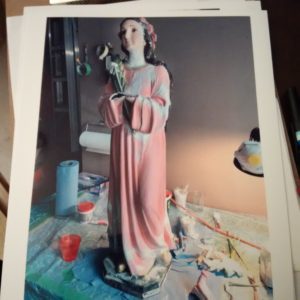
Unsure of what to do next in what seemed to be an impossible circumstance, we contacted Pauline Furmanczyk-Winogron at Brushworks Ottawa (https://www.statuerestorers.com/), who began a restoration process — we were totally amazed:

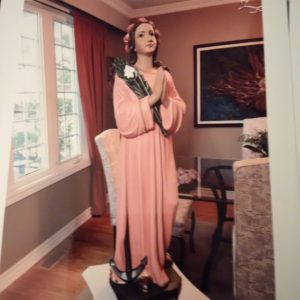
We were pleased with the result :

A video of the whole restoration process can be found below:
St. Philomena is the patron saint of children, youth, babies, infants, priests, sterility, virgins, and apparently, lost causes. Let us include her in our prayers — she will certainly pull together the pieces of the puzzle when things seem in disarray !
In Christo,
Fr. Erik Deprey, FSSP
Pastor
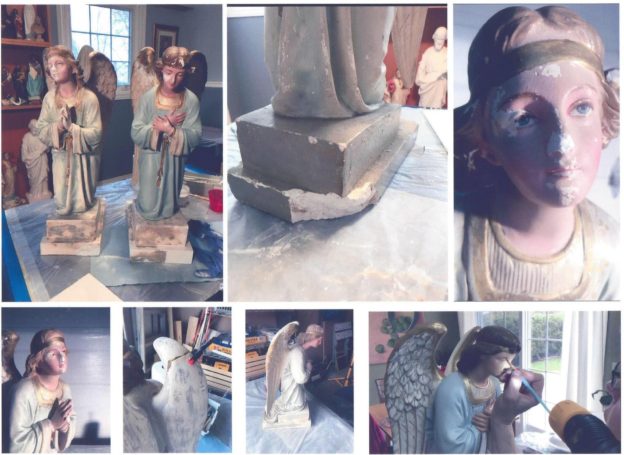
Below you will find a video describing the work which took place for the restoration of our adoring angels. Many thanks to Steve and Pauline Winogron for making this possible !
Fr. Deprey has asks that all families consider praying the 15 decades of the rosary every day as a means to obtain a positive resolution to our current coronavirus crisis.
To many of you this may seem daunting ? If your days are quite busy, consider praying a morning rosary for your morning prayers, then a 2nd rosary spread throughout the day (i.e. pausing from your activities to pray a decade each hour), closing with a family rosary in the evening. This can be done.
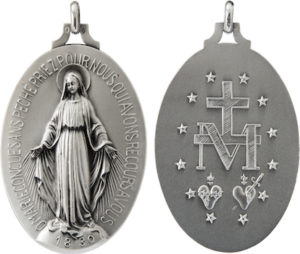
I would also encourage you all to wear the Miraculous Medal of St. Catherine Labouré which was first produced by the Daughters of Charity. During the cholera outbreak in Paris in 1832, which claimed 20,000 lives, the first medals were being produced. The sisters started to distribute the first 2,000 of them, especially to infected people who filled the hospitals. The healings increased, including a lessening of emotional distress. So great was the effect that the people began to call it the “miraculous medal”. We need all the help we can get !
Mary, conceived without sin, pray for us who have recourse to thee ! Amen.

You may view an FSSP daily Mass either live or recorded from the same day. Open the link below for more information.
In this troubling time, you should know that God and His Church have not abandoned you. Even with the prohibition of public Mass and Communion Services, there are still many sources of grace which are open to you. I would like to discuss two of them here – Spiritual Communions and the General Fruits of the Mass.
Following the teachings of the Catechism of the Council of Trent(1), also known as the Roman Catechism, there are three ways in which one can receive Communion: (1) Sacramentally-only; (2) Sacramentally-and-Spiritually; and (3) Spiritually-only.
Those who receive Communion while knowing they are in a state of Mortal Sin are said to receive Sacramentally-only. This is because, while they truly receive the Body, Blood, Soul, and Divinity of Christ under the appearances of bread and wine, they do not receive any spiritual benefits. On the contrary, they incur an additional sin.
Those who receive Communion Sacramentally-and-Spiritually receive the Body, Blood, Soul, and Divinity of Christ under the appearances of bread and wine and do receive spiritual benefits.
Those who receive Communion Spiritually-only receive the spiritual benefits of Communion without receiving the Body, Blood, Soul, and Divinity of Christ under the appearances of bread and wine.
The Catechism goes on to explain that those who receive Spiritually-only “are those who, inflamed with a lively faith which worketh by charity (Gal. 5:6), partake in, wish and desire of that celestial bread.” There are several things that should be noted from this passage.
The first is that in order to receive Spiritually-only, one must be in a state of grace, as the theological virtue of charity and Sanctifying Grace always exist together. So, one must have Sanctifying Grace, or be in a state of grace, in order to make a Spiritual Communion. If you are not in a state of grace, receive sacramental absolution as soon as you can (and be praying Acts of Contrition in the meantime). Editor’s Note: Even in the absence of public Masses, many parishes are still offering Confessions. Check with your parish for details.
Next, it is important to note that a Spiritual Communion must include a wish and desire to receive Sacramentally-and-Spiritually even though such a reception at the current time is not possible. It would be enough, then, when beginning to make a Spiritual Communion to pray, “Lord, I wish to receive You in a sacramental and fruitful Communion, but, as I can’t right now, I wish to receive You spiritually,” and then continue to pray as you would when receiving Sacramentally-and-Spiritually. There are prayers which are recommended by the Church for making a Spiritual Communion (Editor’s Note: St. Alphonsus Liguori’s version is included at the end). They do not necessarily need to be used, and one can draw phrases and ideas from them, based on one’s own dispositions, to prepare one’s own.
Spiritual Communions can be made at any time during the day or night, and as many times as one wants. One does not need to be in a church, in front of the Tabernacle, or even in front of a holy image. Spiritual Communions can be made anywhere, although clearly, it would be unfitting to make them in places ill-suited for virtue.

We should not worry that our sanctification is in some way impeded by receiving Spiritually-only and not Sacramentally-and-Spiritually during this time. As the Catechism states, those who receive Spiritually-only “receive, if not the entire [spiritual benefit of a Sacramental-and-Spiritual Communion], at least very great fruits.” So, the graces received from Spiritual-only Communions can be as great as the graces received in a Sacramental-and-Spiritual Communion.
But, in order to receive as many graces and fruits from a Spiritual Communion as one can, or even from a Sacramental-and-Spiritual Communion, one must be properly disposed. The better disposed one is, the more graces one is able to receive. To properly dispose oneself, one should pray preparatory prayers before receiving Sacramentally-and-Spiritually. These prayers can be found in hand Missals and elsewhere, or one could pray using one’s own words. How long one should spend praying such prayers will depend on the other duties one has to fulfill. This is why it is important to arrive with time before the start of Mass so that one can pray these prayers, if one is planning on receiving (remember that one is only required to receive Communion sacramentally once a year from the First Sunday of Lent to Trinity Sunday in these United States). One could also pray these prayers at home before departing for the church if doing them at the church would be difficult. To make a Spiritual Communion fruitful, one should dispose oneself in the same manner, adjusting the texts of the prayers as necessary. Preparations before receiving either Sacramentally-and-Spiritually or Spiritually-only should include some form of an Act of Contrition.
We know, however, that we attend Mass for more than just receiving Communion. When we attend Mass, we give God the worship due to Him as our Creator and our Redeemer by offering up to Him in an unbloody manner the bloody Sacrifice of Christ on the Cross. The two-fold Consecration of the bread and wine makes the Sacrifice of the Cross sacramentally present. As Christ’s Sacrifice is present, the fruits from that Sacrifice are made available to the faithful. These fruits are placed in four groups – (1) Ministerial Fruits, (2) Very Special Fruits, (3) Special Fruits, and (4) General Fruits.
The Ministerial Fruits are those fruits which are offered to those on whose behalf the Priest is celebrating the Mass. The intention listed in the bulletin for the Mass, for example, would be the recipient of these fruits (if the intention is one who can receive them).
The Very Special Fruits are those which are offered to the celebrating Priest Himself. As he is offering the Sacrifice of the Mass in persona Christi for others and for himself, these fruits are made available to him.

The Special Fruits are those offered to those who are cooperating in offering up the Sacrifice of the Mass by any external act (besides the Priest). This cooperation includes being physically present at Mass, but also by contributing materially to the celebration of the Mass. Those who have donated flowers, candles, vestments, liturgical vessels, and other such things being used in a Mass – including the church building itself – are all offered Special Fruits from that Mass. The amount of fruit offered to each is proportional “to their closeness of cooperation”(2) to the Sacrifice. So, the Altar Server in the Sanctuary will be offered more Special Fruits than that which will be offered to those in the pews.
Note, however, that there is a difference between the fruits being offered and the fruits received. The amount that is received is dependent upon one’s disposition. So, while the Altar Server might be offered more fruits, he may receive less than some in the pews as they, while offered less, were better disposed and thus actually received more than the Server. This is why, again, prayers of preparation before Mass are so important, not just for the reception of Communion, but also for receiving the fruits that will be made available and for worthily offering the Sacrifice of the Mass through the hands of the Priest.

Lastly there are the General Fruits. These fruits are offered to all members of the Church, and even to those outside of the Church for their conversion. In order to gain these fruits, again, one must be properly disposed. This is why morning prayers and offerings are so important and why one should include in one’s morning prayers words to the effect of “Lord, during the course of this day, bestow upon me any Indulgences whose requirements I may fulfill and all fruits available to me flowing from all of the Masses said throughout the world today.” As Masses will continue to be said privately during this time, you should avail yourselves of these General Fruits which are produced. Additionally, if you feel that you qualify for Special Fruits due to any contributions you may have made, be sure to ask for those fruits also.
Hopefully you are able to see that the practices explained above are not to be used only during this unhappy time. These lessons should be integrated into the spiritual life of every Christian so that each may draw from all of the abundant sources of grace available to him. +
Spiritual Communion by St. Alphonsus Liguori:
My Jesus, I believe that You are present in the most Blessed Sacrament. I love You above all things and I desire to receive You into my soul. Since I cannot now receive You sacramentally, come at least spiritually into my heart. I embrace You as if You were already there, and unite myself wholly to You. Never permit me to be separated from You. Amen.
(1) Part II: The Sacraments – The Eucharist
(2) O’Connell, The Celebration of the Mass (1964), p. 39, n. 6.
So this week I was reading some comments from a priest I highly admire, Fr. George Rutler, who is pastor of the Church of St. Michael the Archangel in New York City, where at this time there are a lot of people in hospital, so many that the United States Navy sent a naval hospital called the Comfort to help out. This ship was actually called in during the 9/11 disaster and Fr. Rutler remembered it well because his parish was near the epicenter of the disaster. And as Fr. Rutler was looking out his rectory window at this naval hospital floating by, with memories of 9/11 flashing in his mind, he reflected on the current extraordinary situation of the closure of churches for reasons of public health during the current virus pandemic, and wrote this:
“With powerful shock this Lent, mortifications have been imposed by circumstances beyond human control and not chosen by the exercise of free will. Now the Passion will be more powerful, because the Gates of the Temple are closed.”
In the First Holy Week, “on the Mount of Olives, three of [the apostles] slept a depressed sleep, haunted by anxious confusion”.
And then, after Our Lord was betrayed and taken away and eventually crucified and buried all the “the holy apostles thought themselves deprived of the One they hoped might be the Messiah”.
In other words at the time the people of God felt abandoned.
He continued by saying:
“Varying circumstances in every generation have given the impression of being abandoned by the One who had promised to be with us always.”
And then Fr. Rutler closed his reflection with a quote from Blaise Pascal who said:
“Jesus will be in agony until the end of the world. We should not sleep during this entire time.”
I found this last statement particularly striking. “We should not be sleep during this entire time”.
Indeed.
He was not talking about physical sleep, but of the dullness of mind that so often sets in when our priorities are in the wrong place.
As I have said to people who have been coming here for confession throughout the past couple weeks, we need to look at this time of trial in a supernatural way.
God is permitting this.
There is not much we can do about it. We therefore need to supernaturalize these circumstances and take advantage of them for our spiritual benefit.
Remember that Lent is a preparation, where we look to the death of Christ and His resurrection. But our whole lives are in a sense a kind of Lent. Because there will be a death as well, and after that death, if we are united to Christ, we can hope for a resurrection. So we should look at our entire lives as a preparation, just as Lent is a preparation.
Again, Fr. Rutler says that “we should not sleep during this entire time”. In other words, we should be alert. We should be careful. We should be keeping vigil. Our senses should not be dulled to our first duty of prayer and penance during this time. We should not be spending hours of our day on the internet, looking for the latest answers to our questions, constantly searching for the latest headlines, the latest controversies, the latest conspiracies.
My dear parishioners, the answers to your questions and to mine are found in Jesus Christ, they are not found on the internet!
You would perhaps spend much more productive time in God’s sight by focusing more attention on your life of prayer, on your sins and their consequences, on the duties of your present state of life. Sending an email to Fr. Deprey at two in the morning is not a good sign!
The World Wide Web is well described – because it is a web, and on every web there is a spider, trying to catch you and suck the life out of you.
You need to be taking care of your spiritual life! What are you doing with your day? What are we really doing with all this unexpected time God has given us to prepare for the great Feast of Easter? It would seem that most of us have more time on our hands these days, given the circumstances.
St. Paul says in his letter to the Romans, “it is now the hour for us to rise from sleep. For now our salvation is nearer than when we believed. The night is passed and the day is at hand.”
In the confusion and periodic panic of our current circumstances, we need to each set our priorities this week. What will they be? Have we perhaps taken Our Lord for granted? It is so true that so often we don’t appreciate something until it is taken away from us.
We know that Holy Week is the most important week for us as Catholics and yet we find ourselves, in a sense, cast out, like the public penitents of the early church, who had to do public penance for their sins during Lent before being re-admitted to the Holy Temple.
Is this a message we understand?
This is indeed a time for mourning. This is a time for true Penance. Our sins have caused the wounds of Christ. Our sins have nailed Him to the cross. Our sins, are the cause of death and destruction and pandemic.
We must, as St. Ignatius of Loyola urges, make an effort to grow sad and lament because Christ goes to His death. He hides Himself, He hides His divinity, desiring only to suffer in order to atone for each and every sin you and I have committed. Now is the time for self-examination, now is the time to ask yourself the question: If Christ died for me, what will I do for Christ?
I would like to share with you an act of contrition which one of our parishioners shared with me a few months ago. I was quite taken by it as I had never heard it before. I thought it was so beautiful and that you might find it to be of benefit as you seek this week to reflect over your life and bring yourself to true contrition and renewed repentance. It is best read slowly:
Forgive me O Lord,
forgive my sins;
the sins of my youth,
the sins of my age,
the sins of my soul,
the sins of my body;
my idle sins,
my serious voluntary sins;
the sins I know,
the sins I do not know;
the sins I have concealed for so long,
and which are now hidden from my memory.
I am truly sorry for every sin, mortal and venial,
for all the sins of my childhood up to the present hour.
I know my sins have wounded Thy Tender Heart,
O My Saviour, let me be freed from the bonds of evil through
the most bitter Passion of My Redeemer.
Forgive me Lord, for I have sinned. Amen.